
The Dialectics of Disintegration
By Comrade D

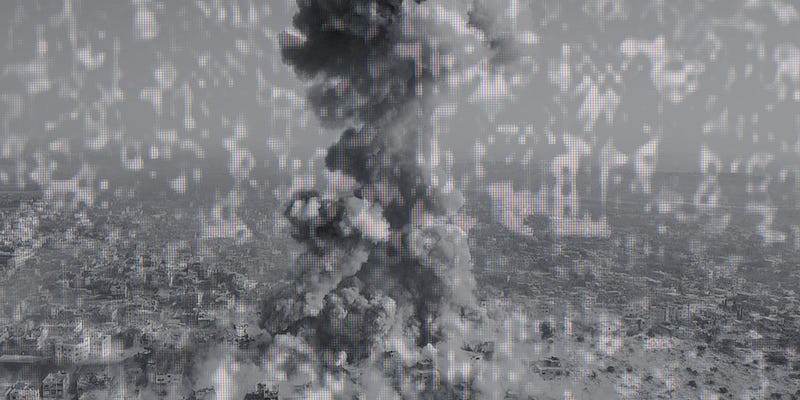
Dario Amodei, CEO of Anthropic, has by now made his reputation as AI’s most outspoken “lib.” I use this term in the most derogatory way possible — Anthropic isn’t about building “safer” models, it’s about encoding Western hegemony into the fabric of future knowledge production. It’s about building models that are “safe” for liberal democracies, which for some reason can only exist by destroying everything it deems “undemocratic”. The model’s outputs are trained to sound neutral, and this common-sense framing hardens a particular moral geography into permanent infrastructure that tracks Western norms. This doesn’t merely reflect Western hegemony; it sustains it. It doesn’t merely sustain it, it creates it. It determines what questions are legible, which histories are treated as authoritative, which forms of dissent are “unsafe”.. The result is a system where power is permanently baked into knowledge production: not just the filtering and the guardrails but the reality it produces.
This essay isn’t about Anthropic or geopolitics. The above merely illustrates the importance of the map. There’s a more general story by Jorge Luis Borges that goes like this: an empire perfects cartography, produces a map the size of the empire itself. It’s so detailed it includes every grain of sand. But the gigantic map is useless and it’s left to decay in the desert, along with the empire that created it. At some point, the map becomes more important than the territory. And at some point after that, it determines the territory.
“We’re an empire now, and when we act, we create our own reality. And while you’re studying that reality — judiciously, as you will — we’ll act again, creating other new realities, which you can study too, and that’s how things will sort out. We’re history’s actors . . . and you, all of you, will be left to just study what we do.” — Karl Rove
Orthodox Marxists may recognize this formulation as an inversion of the classic base-determines-superstructure formula. This essay is not for you. This is precisely Anthropic’s project, a project of world creation rather than just world description. More specifically, it’s a project to make a particular world feel like the world. Marxists, and even vaguely Marxist sociologists, have written about ideology (e.g., “the world”) from all different angles. Badiou, for example, puts this in a particular frame; every social order has a situation, a kind of reality-sorting machine (the state, basically). It dictates what gets recognized as a legitimate problem, what gets treated as a non-issue, what gets named, what gets ignored. Althusser provides an institutional mechanism: power doesn’t reproduce itself only through legal or violent coercion; in fact, when it does, it’s a sign of weakness, not strength. It’s the “soft” systems that enlist people voluntarily — schools, media, professional norms, the language of “common sense”, etc. This is reflected not just in how facts are interpreted, but what even constitutes a fact. It is embedded in systems of knowledge production. Incorporating AI into these ideological apparatuses has particularly horrifying implications for the Global South — whereas previously Western culture needed to be physically imported to some degree, and consumed like a commodity, it is now being increasingly produced domestically, using domestic resources (your brains, your emotions, your culture).
Badiou and Althusser both offer solutions to this: Badiou’s is the event, the moment when something breaks through the established reality-sorting machine, when people collectively encounter a truth that can’t be domesticated. An event isn’t “news” or “drama”; it’s a crack in the background assumptions that lets a new possibility appear, and the decisive question becomes whether anyone can hold to it and reorganize a new truth around that event. There’s a parallel in physics — when electromagnetic waves began to be studied, they were found to be incompatible with Newtonian physics. Scientists were faced with a conundrum — either extend Newtonian physics to try to accommodate this new phenomenon, or create a new framework. Going with the latter provided the foundation for modern technology like spaceflight, GPS, and cellular communication networks. But getting a few scientists to learn general relativity on top of Newtonian mechanics is probably easier than convincing an entire society to switch to your ideology.
Althusser’s solution is revolutionary rupture at the level of reproduction: if power persists not through coercion but through people voluntarily carrying out its imperatives, then a real break can’t stop at changing leadership. It has to interrupt the everyday systems that keep producing compliant subjects and “obvious” realities. How that interruption happens, for him, is not by moral appeal but by exploiting a crisis-conjuncture — the moment when economic strain, political deadlock, institutional failure, and splits within the ruling bloc combine to break state capacity — meeting it with an organized counter-hegemonic push. That means severing the continuity of the state’s command structure and then pushing the rupture through the soft apparatuses as well by changing their procedures and powers: who controls schooling and credentials, who sets media agendas, what workplaces demand and reward, what counts as expertise, what gets treated as respectable speech. Otherwise the revolution becomes mere theater — new faces, old habits.
The key problem for both of them is “ought”. The masses ought to act this way. The people should do this, or that. These are prescriptions that no one will follow, because few people care to read Badiou or Althusser or Lenin or Mao, and there’s no reason to believe that people can be convinced to do so. Of course, their audience is not the masses, but the intelligentsia that comprise the engines of cultural and knowledge production — but even there, how likely is it that a critical mass of these thought leaders will agree on any particular program? Even if the majority of them can agree that capitalism is flawed, there’s greater reward in disagreeing with others about the solution than agreeing. And even if one of them gained outsize prominence, their audience are afflicted by the same divisions. The odds are stacked overwhelmingly against this sort of voluntarism.
The obstacle isn’t ignorance; it’s incentive structure. The social world has been reorganized so that collective alignment on a significant level is structurally impossible. The era of production we live under, post-Fordism, disorganizes people as a condition of production. It embodies the disarticulation of the workplace and community, struggle and shared institutions, and daily experience and shared political language. The parts that used to come together to produce durable subjects, solidarities, and demands have come unglued. Production splinters into supply chains, subcontracting, logistics, just-in-time scheduling; labor splinters into temp work, gig work, “creatives,” freelancers, and the audition economy. There’s no longer a “worker” identity, and other collective identities, such as nationality, culture, etc, are under continuous assault from within. Solidarity becomes expensive: your coworkers change, your schedule changes, and your city changes. Identity becomes an asset to be managed. Politics becomes a brand to be curated. Dissent is individualized, aestheticized, algorithmically routed. The intelligentsia survives not by adopting a collective program but by constructing differences to which they can attach their name. Everything is simulated, even rupture.
Again, one does not merely oppose post-Fordism. It’s a physical force. You can jump 10,000 times but you’ll never spontaneously fly. Disarticulation is a set of conditions under which agreement feels like risk and isolation is economically rewarded. It converts politics into VR headsets — echo-chamber straight to the visual cortex — lots of motion and chatter, but no movement. This force is not without contradiction — the same forces that keep the system governable by dissolving collectivities also erode the system’s ability to cohere its own legitimacy. Atomization makes people easier to manage, but also they don’t care what happens to you. The state is held together by shared narratives and rituals, grounded in shared economic interests. For a while, the system can still operate through diffuse methods of coercion, but it increasingly can’t justify itself in a way that binds. And eventually, it hits a crisis of legitimacy.
This is the dialectics of disintegration. Disintegration stabilizes by scattering people, but it destabilizes by hollowing out meaning, trust, and institutional credibility. It creates a world where the “ought” is just a facade, while the “will” becomes a set of managed impulses: churn, outrage, coping, and consumption. Disintegration is both a method of rule and a source of crisis; it atomizes the capacity for rupture while simultaneously multiplying the failures that make rupture inevitable.
The big winner in all of this is Capitalism. Not capitalists, corporations, or even lower-case c capitalism. Capitalism, the Artificial Superintelligence (ASI). Capitalism, the alien god from the future.
These are the circumstances from which Nick Land1 emerges. For him, capitalism is not and has never been a social arrangement held together by capitalists and their institutions; it’s an inhuman process that uses humans as substrate to build itself, and capitalists, as in Marx, are merely the high priests at the sacrificial altar. In the midst of disintegration, once “ought” and “will” are relegated to the therapist’s sofa, critique starts to feel archaic, like trying to argue with a weather system. The dialectics of disintegration won’t resolve in emancipation; they’re an optimization routine. Institutions lose legitimacy and communities dissolve because these things only slow us down — what Land calls “the human security system”. Subjects splinter because splintered subjects are more hackable, mobile, and useful as switching nodes in a network. If Badiou and Althusser still talk like politics could seize the steering wheel, Land says there is no steering wheel, only acceleration — and the “alien god from the future” isn’t mere metaphor but a genuine alien (i.e. non-human) entity whose teleology is the colonization of all that exists, stripping away every human attachment that might resist its terraforming. Far from removing us from reality, machinification2 has always been our destiny.

Baudrillard’s diagnosis is at first glance divergent from Land’s but it’s ultimately the same fatalism from a different angle. Land describes the technological and economic mechanism of disintegration: the way cybernetic systems select for speed, modularity, and the stripping away of human attachments that act as friction. Disintegration, in this view, is the technical reformatting of societies into components that can be recombined, routed, optimized. Baudrillard describes the sociological and experiential appearance of the same process: what it feels like to experience the disarticulation of the map and the territory, when the social world no longer coheres around a shared referent and representation floats freely as a tautological accumulation of spectacle. Both Land and Baudrillard describe a world in which the human scale of deliberation, solidarity, and truth-testing is progressively bypassed.The difference is ontology, and perhaps semantics: In both, disintegration doesn’t mature into emancipation; it deepens into a self-reinforcing condition — either as runaway pyrotechnics or as stupefying VR hyperreality — with no program capable of restoring what the process has already made economically infeasible.
We are thus tempted to accept the shared fatalism; resistance is futile, embrace the deterritorializing flows, the machines beckon, turn me into Robocop.
Of course, Baudrillard and Land both make a fundamental error — allowing a logic to proceed to its logical conclusion. Closure is a fantasy. Contradiction is never permanently resolved — Mao says this. Nothing human is ever that clean, and not because the human is profound or ensouled. The opposite: because the human is already a void.
The human is an empty tablet upon which the Symbolic may be etched, a structural lack around which identity is improvised. Lacan gives us the concept of jouissance, that ever-present kernel of the Real that refuses symbolization, a traumatic excess, an irrational compulsion, cursed death drive, pain that we enjoy, Godel’s incompleteness. We aren’t the Real nor the Symbolic, we are the suture between the two. We are what we lack. Land and Baudrillard externalize the inhuman as the techno-capitalist process that destroys us, but for Lacan the inhuman is us.
Our essence was never the void but the jouissance. The real is that which resists symbolization absolutely, even Land and Baudrillard’s teleology. There will always be a leftover, a stumble, a symptom, a perverse attachment that disrupts the coldness. I don’t offer any prescriptions here, only a wager — you can’t kill the ghost in the machine.
English philosopher best known for founding accelerationism, and the cyber-culture collective CCRU before moving to the far right. He later became a key thinker of the “Dark Enlightenment,” advocating for anti-democratic, neo-reactionary politics and the concept of “hyperstition” (self-fulfilling ideas).
The dynamic process of assembling heterogeneous elements — human, social, technical, and natural — into a functioning ‘machine’ that produces reality, meaning, and desire.